
What to look out for
A heritage apple tree was evaluated down at the orchard on Tuesday 27th September 2016.
At a height of around 2.5 m and a similar spread, the tree showed evidence of pruning in its formative years including the central leader having been taken out, but regular pruning had not been carried out for at least four years. There were several crossing branches and some were dead, diseased and damaged.
The tree was protected from sheep damage by a wooden structure of three posts reinforced by timber top bars with wire mesh, but there was no rabbit guard. Suckers could be seen near the base of the tree and there were weeds and grass within the protected area, next to the trunk.
There was evidence of canker where the branches were pinched and the bark rough and wrinkled. Sap-sucking woolly aphids with their white cotton wool-like secretion were also present on some branches. Raised corky growth scars could be seen on the apples – evidence of capsid bugs feeding on young fruit. There was also some brown rot around apples affected by apple scab.
Some of the leaves showed a speckling and shaking them encouraged tiny leaf hoppers to jump up from where they had been sap-sucking. Other leaves showed trials of damage caused by apple leaf mining moths, and a few wasps buzzed around and feeding on the fallen apples.
Despite all of this, all is not lost!
Fortunately, the weather had not been too dry during the summer so there was no evidence of powdery mildew on new shoots. Tortrix moth caterpillars often burrow into apples but there was no evidence of this or the bright green caterpillars themselves. No aphids were seen either.
Light winter pruning during the dormant period (between November and March) including removing the dead, diseased and damaged branches will minimise the problems and will encourage new fruiting wood growth – see the RHS Advice on pruning.
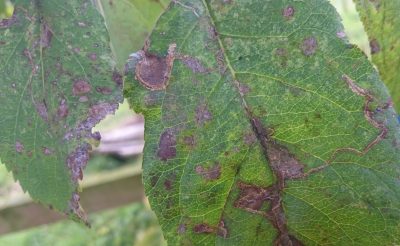 Although the capsid bug scars apples may not look appetising, it is in fact fine to eat and store them. Leaf miner and leaf hopper damage on the leaves looks unsightly but in fact doesn’t harm the tree or the apple crops.
